How software helps keep food product technical data sheets up to date
In the food industry, keeping technical data sheets up to date is essential to ensuring regulatory compliance, food safety and customer confidence.
However, many companies still manage this information manually, using scattered spreadsheets or duplicate documents that lead to errors and wasted time.
In this article, we explore best practices for managing technical data sheets, the most common mistakes and how tools such as PIM software can automate processes and ensure that all technical documentation is updated in real time.
Common problems in managing technical data sheets
Managing technical data sheets typically involves several departments, including quality, R&D, production, marketing and sales.
Without a centralised system, the following problems are common:
Conflicting versions: a risk to information consistency
One of the most common problems in managing technical data sheets is the existence of conflicting versions.
When different departments — such as quality, R&D or marketing — work with local copies or documents shared by email, it is easy for each team to modify a different version.
This lack of organisation creates confusion, leads to data errors and delays final product approval.
Centralising information in a single source of truth prevents this problem and ensures that all teams always work with the latest version.
Duplicates and manual errors: small differences, major consequences
Manual processes are one of the main causes of errors in technical data sheets.
Small differences in ingredient descriptions, percentages or nutritional values can lead to duplicates or inconsistencies between products.
These errors not only make internal management more difficult but can also affect regulatory compliance and communication with distributors and customers.
An automated system makes it possible to detect variations and maintain data consistency throughout the supply chain.
Lack of traceability: no control over changes made
When information is managed manually or through spreadsheets, it becomes almost impossible to know who changed what and when.
This lack of traceability complicates internal audits and reduces data reliability.
With a digital management system, every modification is recorded, making it possible to audit the complete change history and maintain full control over how each technical data sheet evolves.
Difficulty sharing up-to-date information: a barrier to commercial efficiency
Sharing technical information with distributors, retailers or online platforms is another major challenge.
In many cases, documents are sent by email or manually uploaded to different portals, increasing the risk of outdated information being shared.
A centralised tool allows data to be synchronised automatically, ensuring that every channel has access to the correct, up-to-date version of each product's information.
This saves time, prevents errors and improves the experience of business partners.
These problems do not just affect internal efficiency. They can also lead to regulatory non-compliance or a loss of customer confidence.
What a complete technical data sheet should include
A food product technical data sheet must contain all the information necessary to ensure safety, traceability and transparent communication with customers.
The essential sections include:
- Product identification: product name, internal code, format and presentation.
- Ingredients and allergens: complete list in accordance with current legislation.
- Nutritional information: values per 100 g/ml and per serving.
- Storage conditions and shelf life.
- Manufacturer or distributor details.
- Regulatory compliance and certifications (IFS, BRC, ISO, etc.).
- Labelling and packaging information.
Keeping all this information up to date and consistent across products and markets is essential to avoiding penalties and ensuring transparency.
Automation to reduce manual work
Using software to keep technical data sheets up to date makes it possible to digitalise and automate much of the process, minimising errors and saving time.
Some of the key benefits include:
Data centralisation: a single source of truth for the entire organisation
One of the main benefits of digitalising technical data sheet management is the ability to centralise all data in a single environment.
This ensures that every department — quality, R&D, marketing, production and sales — always works with the same information, preventing duplicates, confusion and isolated documents stored in emails or shared folders.
Centralisation simplifies coordination between teams and ensures that updates are immediately reflected in all processes that depend on them.
Management by exception: saving time and avoiding unnecessary reviews
Manual management requires teams to review entire technical data sheets, even when an error affects only a minor detail.
With a digital system, workflows are optimised through management by exception, which sends notifications only when a relevant change, inconsistency or item requiring validation is detected.
This eliminates the need to spend hours checking information that is already correct, allowing teams to focus on genuine issues and significantly reducing the administrative workload.
Automatic version control: full control over changes
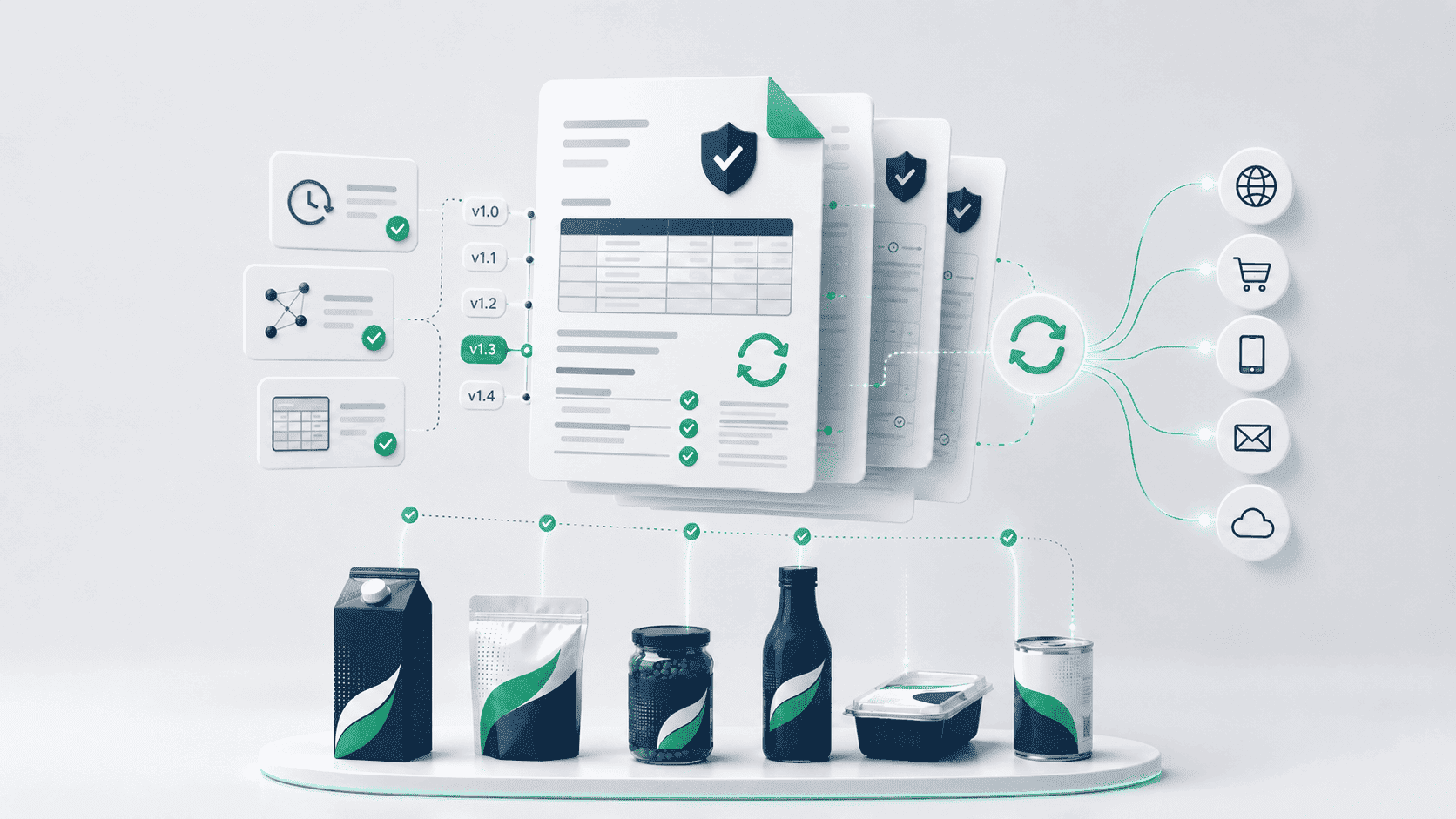
Automatic version control ensures that every modification made to a technical data sheet is recorded, including the date, author and details of the changes.
This complete traceability not only provides transparency but also facilitates audits, internal reviews and comparisons between versions.
It also allows previous versions to be restored in the event of errors, providing greater security and control over the development of each product.
Automatic validation: complete and consistent data from the outset
Automatic validation helps prevent errors commonly associated with manual management, such as incomplete fields, incorrect formats or inconsistent data between products.
The system automatically checks that all information meets the established requirements — whether regulatory, internal or customer-specific — reducing errors before they reach critical stages of the process.
This ensures that technical data sheets are always properly structured and ready to be shared or published.
Thanks to these features, companies can maintain control over their technical data sheets with greater efficiency and reliability, freeing up time for higher-value tasks.
Ensuring real-time updates with Alimentium
Alimentium is a PIM tool designed specifically for the food industry that ensures food product technical data sheets are updated in real time.
Unlike generic solutions, Alimentium combines an approach focused on digitalisation and management by exception, making it possible to:
- Reduce errors and conflicting versions:
Alimentium eliminates one of the biggest problems in managing technical data sheets: conflicting versions. By centralising all information on a single platform, teams always work with the latest version of each document, preventing duplicates, manual errors and isolated modifications across different departments. This ensures data consistency and provides full control over which information is correct at any given time.
- Automatically update documentation across all channels:
With Alimentium, any change made to a technical data sheet is automatically synchronised across all channels where that information is used: catalogues, distributor platforms, e-commerce sites, sales data sheets and internal documentation. This automation eliminates repetitive tasks and reduces the risk of outdated versions circulating among customers or sales teams. Companies become more efficient and ensure that every stakeholder always receives the correct information.
- Ensure regulatory compliance for every product:
The food industry is subject to strict regulatory requirements, and Alimentium is designed to make compliance easier. The platform incorporates automatic checks and validations to ensure that each technical data sheet meets applicable legal requirements relating to ingredients, allergens, nutritional values and certifications. This reduces the risk of non-compliance and allows quality teams to work with greater confidence, knowing that documentation is complete and aligned with current regulations.
- Facilitate collaboration between manufacturers, distributors and customers:
Alimentium supports a collaborative ecosystem in which manufacturers, distributors and customers can work with the same information, updated in real time. The platform enables controlled sharing of technical data sheets, permission management, collaborative data reviews and structured updates. This transparency streamlines commercial processes, reduces misunderstandings and improves relationships between all stakeholders in the food supply chain.
With Alimentium, companies can leave the confusion of conflicting versions behind and ensure that everyone involved in the process always works with the correct information.
Start optimising your technical data sheet management today
If your company still manages technical data sheets manually, now is the time to simplify the process.
With Alimentium, you can centralise all information, reduce errors and ensure access to a single source of truth in real time.
Take the next step towards more efficient and secure management: contact our team and discover how to digitalise your food product technical documentation with complete confidence.