
How automation can reduce human error in food product management
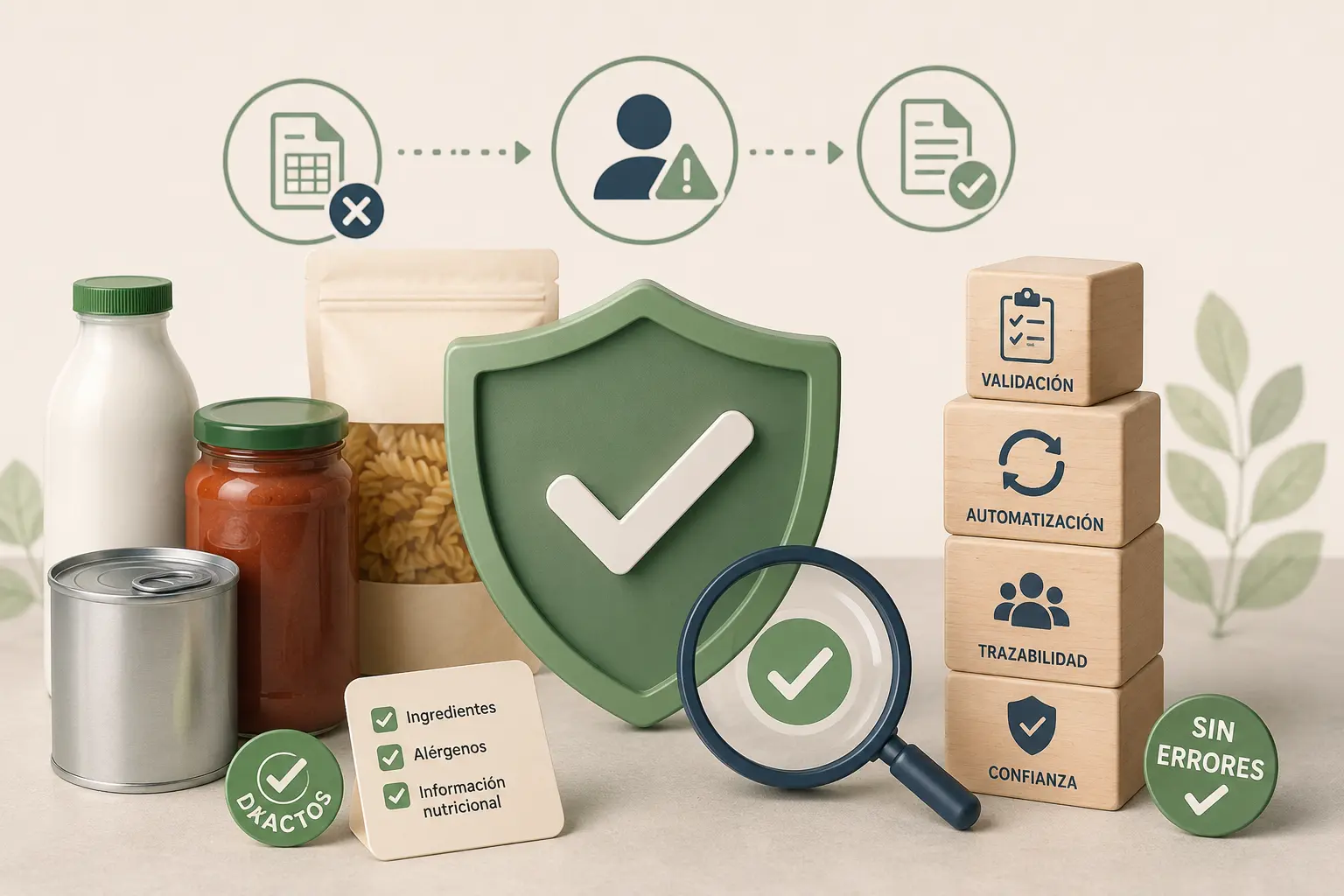
Managing human error is one of the main challenges in the food industry.
In an environment where data accuracy is essential—from ingredients and allergens to technical specifications and nutritional information—human error can have significant consequences.
Duplicates, inconsistencies, or outdated data not only create operational inefficiencies but also put consumer trust and regulatory compliance at risk.
Fortunately, automation and technologies designed to reduce errors in production processes are enabling companies to improve the reliability of their information and achieve higher levels of operational efficiency.
Typical errors in manual product management
In many food industry companies, product information is still managed manually, whether through Excel spreadsheets, emails, or documents and folders shared between different departments.
This method is not only time-consuming but also increases the likelihood of error.
The most common failures include:
- Duplicate records or conflicting versions of the same product.
- Outdated data regarding ingredients, nutritional values, or certifications.
- Transcription or export errors when transferring data between systems (ERP, CMS, catalogues, distributors, etc.).
- Lack of traceability and change control, which makes it difficult to know who modified the information and when.
These seemingly small errors can multiply throughout the commercialisation process and lead to serious inconsistencies in catalogues, technical data sheets, or sales platforms.
Hidden costs of these errors
Beyond the visible impact, errors in product information management have hidden costs that directly affect the company's profitability and reputation.
Launch delays due to endless validation processes
One of the most visible effects of manual management is the constant delay in new product launches.
Quality, marketing, and regulatory affairs teams must spend hours—sometimes days—reviewing, validating, or correcting information before a food product data sheet can be published or distributed.
Every error detected means backtracking in the process, which delays time-to-market and reduces the company's ability to respond with agility to consumer demands or business opportunities.
Loss of trust from distributors and customers
The inconsistencies between catalogues or sales channels directly affect brand credibility.
When a distributor notices that product data differs between versions or platforms, the manufacturer's reliability is called into question. And that trust, once lost, is difficult to regain.
In a market where clear and consistent information is essential for making purchasing or distribution decisions, every error can lead to confusion, complaints, and a perception of poor internal control.
Legal and reputational risks due to data errors
In the food industry, a simple error in the information regarding allergens, ingredients, or nutritional composition can have serious consequences.
Beyond damage to the brand's reputation, authorities may impose sanctions or even demand the immediate recall of the product.
These types of incidents not only entail high financial costs but also have a negative impact on relationships with customers and regulatory bodies.
Ensuring data accuracy is not just a matter of quality: it is a legal obligation and a pillar of consumer trust.
Operational overload and reduced capacity for innovation
Manually reviewing documents and constantly cross-referencing data between systems represents a overload for internal teams, who spend a large part of their time on repetitive, low-value tasks.
This lack of automation reduces overall productivity and limits the teams' ability to focus on strategic projects, such as developing new products or improving processes.
Ultimately, excessive operational workload translates into lower efficiency, more errors, and slower business growth.
Automation with PIM as a solution for human error
Automating processes through automated document management software or a PIM (Product Information Management) system provides a robust and scalable solution for reducing human error, especially in environments where product information changes frequently or must be distributed across multiple channels.
Unlike Excel, which scatters information across separate files, makes version control difficult, and increases the likelihood of different departments working with conflicting data, a PIM system centralises all information into a single source of truth. This allows different teams (quality, marketing, sales, or logistics) to always work with updated and verified data.
Thanks to its validation and control workflows, the system offers the following advantages:
Automatic validation to prevent errors before publishing a product
A PIM system with validation rules allows you to automatically detect errors, inconsistencies, or incomplete fields long before the information reaches catalogues, distributors, or external platforms.
This ensures that every technical data sheet undergoes a systematic quality control check, eliminating the reliance on manual reviews and reducing the risk of incorrect data spreading throughout the value chain.
Version control and elimination of duplicates
Manual document management often generates multiple versions of the same file, leading to confusion and errors.
With a PIM, information is organised into a single source of truth that prevents duplicates and maintains perfectly controlled versions.
Thanks to this approach, all teams always work with consistent and up-to-date data, regardless of the channel or platform being used.
Automated data distribution to all channels
One of the great benefits of automation is the ability to automatically distribute product information to catalogues, eCommerce, distributors, or internal systems.
By eliminating the need for manual exports and updates, the risk of human error is significantly reduced, and the delivery of accurate information to every customer touchpoint is accelerated.
Complete traceability and auditing with a single click
A PIM system provides a clear and organised view of who modified which data and when, which increases traceability and control over all product information.
This ability to easily audit changes facilitates regulatory compliance, improves interdepartmental coordination, and allows for the rapid identification of the source of any discrepancy or error.
In this way, the PIM transforms a traditionally manual and fragmented process into intelligent, rule-based management, reducing errors and improving the operational efficiency of the entire organization.
How Alimentium prevents critical errors in technical sheets and catalogs
At Alimentium, automation is much more than a technological tool: it is a work philosophy focused on reliability and continuous improvement.
Thanks to its centralised information system, the company manages to maintain data consistency and accuracy at every stage of the process.
The Alimentium system allows for eliminating duplicates and obsolete versions through automated validation workflows, ensuring that the information published is always the most recent.
Furthermore, its permission and review structure ensures that only authorised personnel can make changes, which reduces the margin for error and improves traceability.
Another key benefit is the ability to automatically synchronise information with catalogues, distributor portals, and other sales channels.
This ensures that customers and partners receive consistent, complete data that is aligned with current regulations.
Ultimately, Alimentium demonstrates that the combination of automation and operational efficiency not only reduces human error but also improves competitiveness and trust throughout the value chain.
The future of food management lies in automation
Reducing human error in food product management is a strategic necessity for any company looking to maintain its reputation, comply with regulations, and operate efficiently.
Implementing technologies to reduce errors in production processes, such as a PIM or an automated document management system, allows you to centralise information, automate repetitive tasks, and ensure data consistency at all times.
In a sector where precision and traceability are essential, investing in automation is not just an option, but a competitive advantage.
Take the next step toward error-free food product management
If your company manages large volumes of product information and still relies on manual processes, it is time to move toward more efficient and secure management. At Alimentium we help you identify critical points in your data flow and implement solutions that minimize human error.
Contact our team to discover how we can help you automate your product management and ensure the quality and consistency of your food information.