
What to include in a food product data sheet?
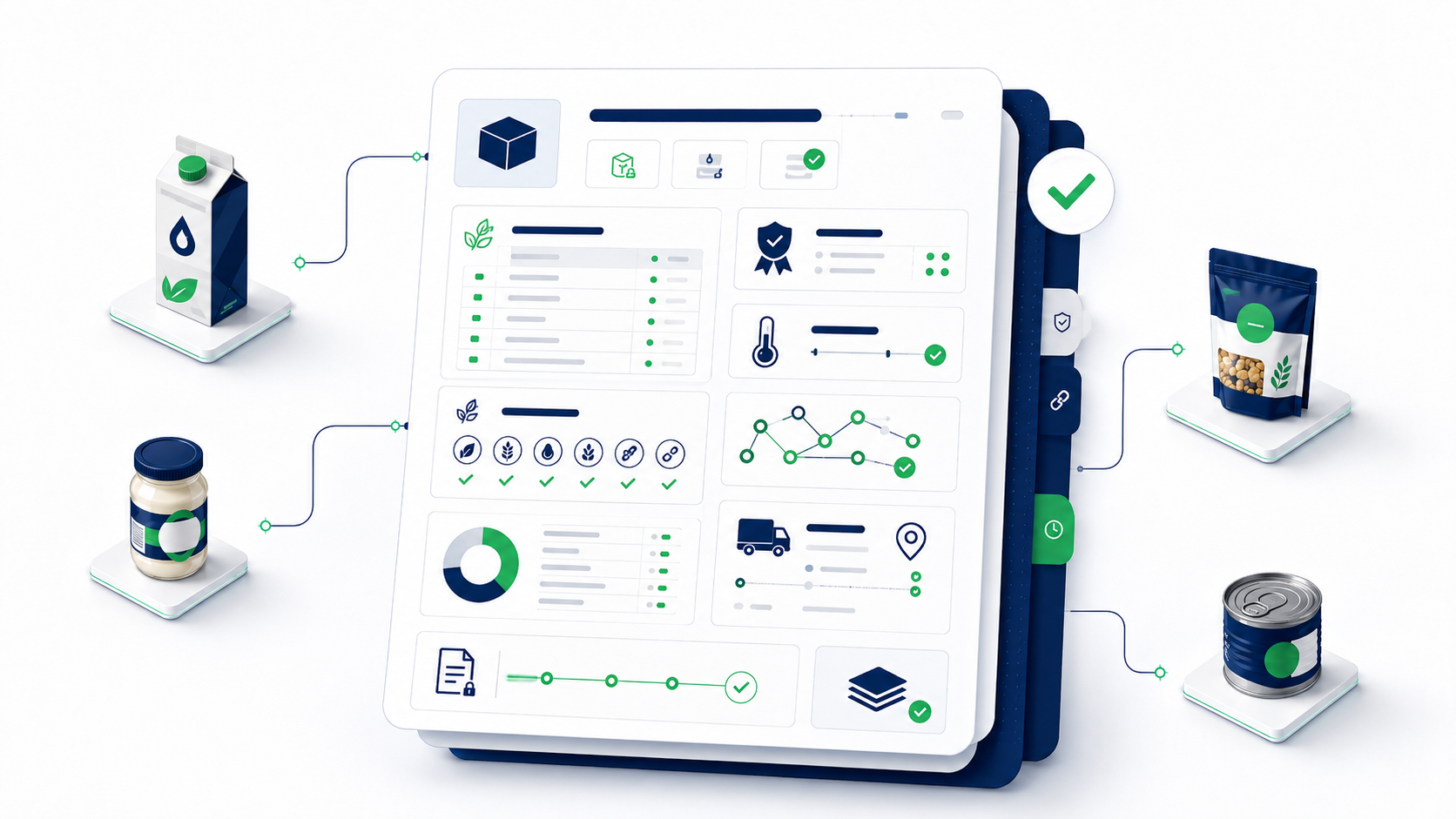
In the food industry, information is just as critical as the product itself. A technical data sheet for food product is more than just an internal document: it is the foundation for regulatory compliance, audit readiness, distributor communication, and consumer safety. In fact, legislation requires every food operator to maintain a specification sheet for every product they sell, as it contains all the essential attributes of the item.
However, when these sheets are managed in Excel or scattered across various documents, the risk of errors, outdated versions, and inconsistent data increases significantly.
In this article, we will explore what to include in a food product data sheet, what European regulations require, what certifications demand, and why digitalization has become essential.
What is a food product data sheet?
To understand its importance, it is helpful to clarify what a food product data sheet is. It is a structured document that compiles the fundamental attributes of a food product and all relevant information about a food item: composition, characteristics, nutritional values, allergens, formats, storage requirements, and legal mandates. Furthermore, legislation establishes a series of mandatory information requirements that vary depending on the type of product, making the specification sheet the documentary support that gathers and organises them.
According to industry standards, a specification sheet must not only comply with regulations but also meet specific customer requirements, making it essential that the content is relevant, clear, and truly useful. In practice, this is key because a specification sheet is not written just to "check a box": it is used to respond quickly and consistently to requests from customers, distributors, and auditors.
A food product data sheet serves as a single, reliable reference for both internal use (quality, purchasing, production) and external use (customers, distributors, audits). In other words, it is the product's "ID card." And, just as importantly, every operator must have a specification sheet for every product they market, precisely because it is the reference document that proves what the product is and what information supports it.
What a technical data sheet must include according to European regulations
European regulations do not leave much room for improvisation. The Regulation (EU) 1169/2011 clearly defines what information must be available and consistent at all times. In practice, the technical data sheet is the document that supports the labeling and demonstrates that the company is in compliance with the law.
Furthermore, there is a common structure for technical data sheets that is recognised internationally, with minor variations depending on the country or target market.
Clear and unambiguous product identification
A food product technical data sheet must begin by identifying the product unequivocally. An attractive trade name is not enough: it is essential to include the legal name, the product category and, where applicable, internal references or codes such as the SKU.
It is also advisable to include an image of the product and a brief description, as this identification not only facilitates sales but also reinforces food safety and traceability when there are different versions or formats.
Manufacturer and food business operator details
The technical data sheet must clearly include the details of the responsible company: registered name, address, customer service contact details, website, and General Sanitary Registry (RGS) number.
For companies with multiple plants or production systems, it is advisable to specify them, as this information is key during audits and official inspections.
Product and ingredient origin and sourcing
The technical data sheet must indicate the origin or source of the product and, where relevant, that of its ingredients, especially in cases where this information is mandatory or significant for the consumer
List of ingredients and allergens: a critical point
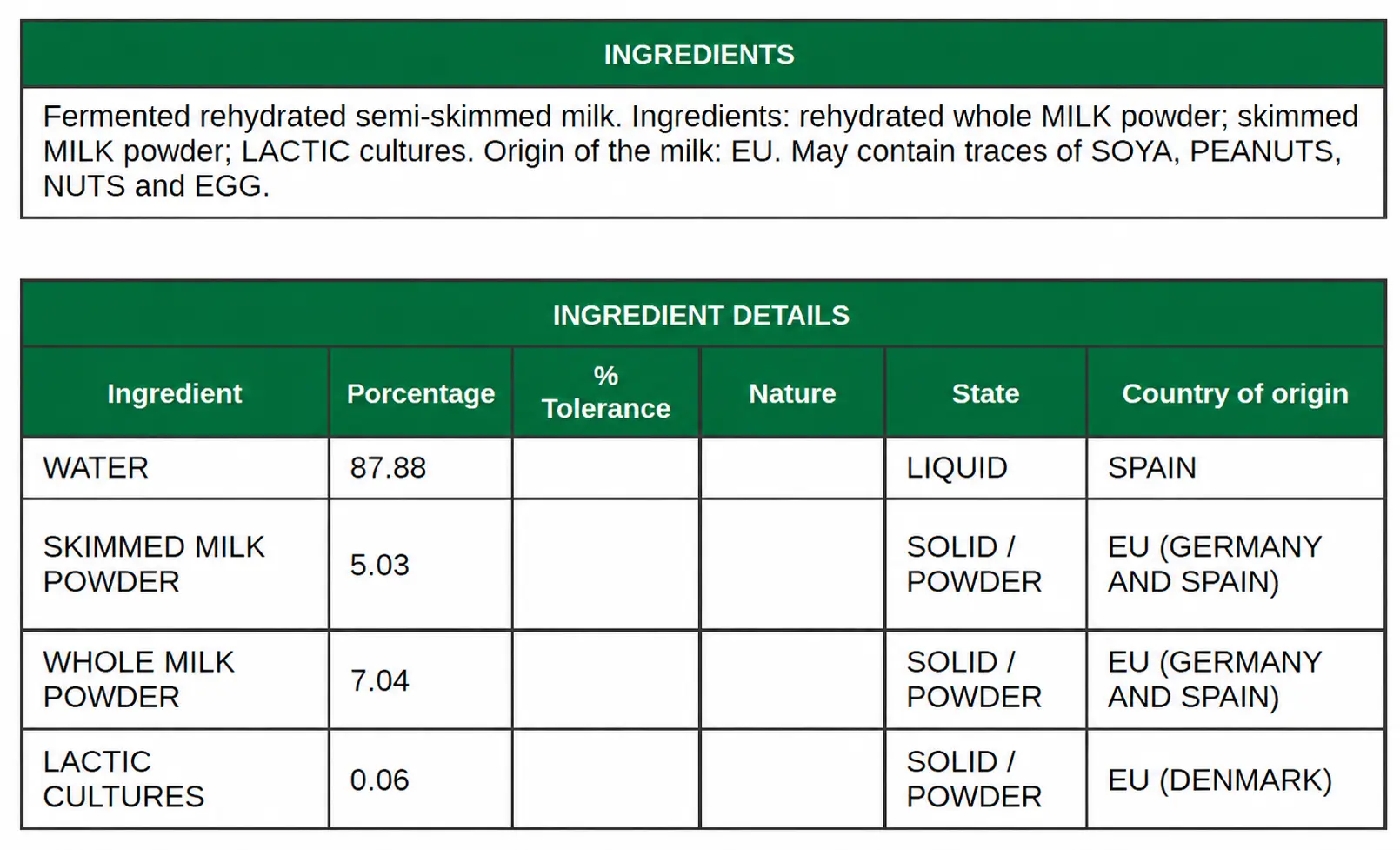
The list of ingredients is one of the most sensitive sections of any food technical data sheet. It must faithfully reflect the actual formulation, respect the descending order by weight and always be aligned with the final product.
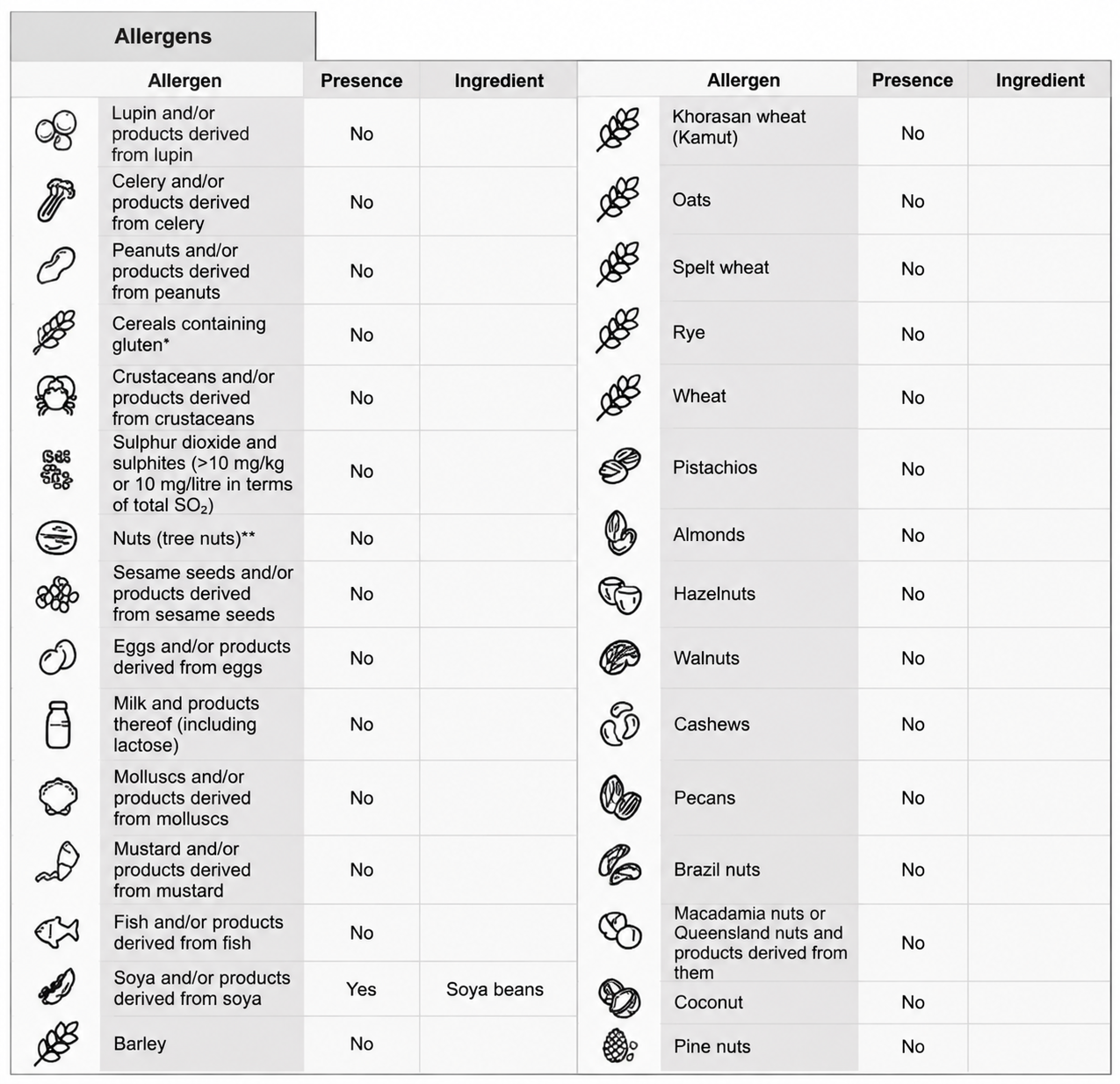
The declaration of allergens and substances that cause intolerances is mandatory and must include both the allergens present and any potential traces due to cross-contamination. These traces are small amounts that may be unintentionally introduced during processing, packaging, or handling. Therefore, this is a point that is closely monitored by both customers and health authorities.
Nutritional information and safety parameters
Regulations require a complete nutritional declaration that is consistent with the final product, preferably presented in a table format and adapted to the target market. And, to complete the product "snapshot" beyond the numbers, it is also common to include its organoleptic characteristics, with a brief description of aspects such as the expected smell, taste, or texture.
In addition, the technical data sheet may include food safety parameters that help to "ground" product quality with objective data. In the section on physicochemical characteristics, for example, values such as water activity, and acidity level (pH), moisture or even ash, among others.
In parallel, it is standard practice to include microbiological characteristics, with the criteria or results corresponding to the type of food. Together, this information provides a higher level of control, facilitates verification during audits, and builds greater trust with clients and distributors.
Storage, use, and shelf life
The technical data sheet must detail optimal storage conditions, both before and after opening, clearly indicating the necessary guidelines to ensure the food is consumed under optimal conditions (for example, 'store in a cool, dry place'). It must also include any specific requirements when applicable.
For certain products, the technical data sheet should also include instructions for use, especially when the food requires preparation, cooking, or specific steps for safe consumption.
Furthermore, the sheet must describe the specific transport and distribution conditions necessary to maintain product safety and quality.
Regarding shelf life, a generic best-before date is usually indicated, specifying when this period begins.
Applicable legislation and regulatory compliance
In addition to listing product data, it is advisable to mention the specific applicable legislation and clearly state that the product complies with it. Ultimately, food legislation is not just "a regulation": is the set of regulations that protects consumer health and establishes obligations regarding food hygiene and safety, and the technical data sheet is the document where that compliance is organized and verifiable.
Beyond the law: additional information requested by distributors and customers
Complying with the law is just the starting point. In the reality of the market, technical data sheets for food products are often much more comprehensive than what regulations require. More and more distributors and brands are requiring that technical data sheet information be prepared for use in digital and e-commerce environments, which requires data to be structured in a clear, consistent, and easily reusable way.
Logistics information and commercial presentation
Distribution chains often require very specific data regarding product presentation: type and material of packaging, available sizes, net and gross weight, and logistics configurations.
This data is key for planning, storage, and sales in large retail outlets.
Certifications and standards compliance
Certifications such as IFS, BRC or HACCP not only evaluate the product, but also the quality and consistency of the associated documentation.
The technical data sheet must reflect the available food certifications and their scope throughout the supply chain, as incomplete information can lead to non-conformities.
Claims, product destination, and target population
It is increasingly common to include product claims, such as “gluten-free,” “vegan-friendly,” or “lactose-free,” always backed by real data.
In this context, the data sheet should also indicate whether the product has been irradiated or if it is derived from genetically modified organisms (GMOs), including, where applicable, statements such as “GMO-free,” “irradiation-free,” or “nanomaterial-free,” provided they are duly justified.
Likewise, the food product data sheet must indicate the target population and, where applicable, explicitly exclude vulnerable groups or individuals with specific allergies.
Common mistakes in manual food product data sheet management
Although it is a widespread practice, managing technical data sheets manually often creates more problems than are immediately apparent.
Disorganisation, duplication, and lack of structure
Working with multiple files leads to duplication, inconsistencies, and difficulties in maintaining a logical order for information.
Without a clear and consistent structure, each data sheet ends up having a different format, which complicates both internal and external use.
Difficulty in maintaining languages and versions
Translating food product data sheets into multiple languages is essential from a commercial standpoint today, but managing it manually increases the risk of errors and discrepancies between versions.
Lack of document traceability
During audits or inspections, not having a history of versions, those responsible, and approval dates creates stress and can compromise the company's credibility.
How a PIM like Alimentium simplifies food product data sheet management
To address these issues, a PIM software specialized in the food industry like Alimentium completely transforms the way you work.
Centralising information into a single source of truth
When product information is managed across multiple files and formats, maintaining control becomes complex. A PIM specialised in the food industry like Alimentium allows you to centralize all technical information in a single, structured environment, where every data sheet follows a logical and consistent order. Ingredients, allergens, nutritional values, logistics data, certificates, and applicable regulations all coexist in one source of truth, accessible to all involved teams.
Version control, accountability, and internal validation
Furthermore, the system incorporates version control, accountability, and validation workflows, which facilitates traceability and ensures that every technical data sheet is always up to date and approved. In day-to-day operations, this eliminates the common "which is the latest version?" question and reduces friction between quality, product, operations, and sales teams, as everyone works from the same reference.
Automatic consistency for changes and less repetitive work
Any change—for example, in a formulation or a nutritional value—is managed consistently, avoiding duplication and manual errors. Instead of manually correcting multiple documents and hoping you haven't missed any, the team can update the information once and maintain consistency across all outputs and formats.
Faster responses and a better experience for customers and distributors
This centralization ensures that all departments work with the same updated and validated data, which translates into faster responses and higher satisfaction for customers and distributors. When you are asked for a data sheet "for yesterday" or a last-minute change, having organised and governed information makes the difference between scrambling and responding with confidence.
Benefits of digitising food product data sheets with Alimentium
Digitising a product's technical data sheet is not just a technological matter, but a real improvement in the way you work.
The Alimentium PIM software offers several advantages, such as:
Greater data reliability and fewer human errors
Digitising technical data sheets is not just about "moving them into a system," but about working with structured and centralised data. This increases the reliability of the information and significantly reduces human error, which is especially important when dealing with food safety, allergens, or formulation changes that leave no room for oversight.
Better analysis and more informed decisions
When information is organised and connected, it stops being a collection of documents that are difficult to compare. With digitised specifications, it is easier to analyse data, detect inconsistencies, and spot patterns (for example, recurring changes in ingredients, formats, or client requirements). In practice, this helps you anticipate needs and make decisions based on evidence rather than intuition.
Customisation by client, market, or channel
Not all clients ask for the same thing, and not all countries require the same level of detail. Digitisation makes it easy to customise information to adapt it to each distributor, market, or channel (retail, foodservice, e-commerce) without duplicating work or creating "copies" that eventually become outdated.
Greater operational agility and more accurate growth forecasts
When your catalogue grows or you enter new markets, manual management becomes a bottleneck. With digitised technical specifications, processes scale better: it is easier to maintain consistency, respond faster, and make more accurate growth forecasts, because the information is ready to be used and analysed, rather than scattered across folders.
Better company image and higher customer satisfaction
A complete, consistent, and always up-to-date specification conveys professionalism. That consistency improves the company's image, increases trust, and reduces back-and-forth with clients and distributors. And when information flows and arrives on time, the result is simple: less friction and greater satisfaction.
From technical specifications to real information control
Knowing what to include in a food product specification is essential for regulatory compliance and responding to clients and certifications. But how that information is managed is just as important.
If your company is still relying on Excel and scattered documents, it might be time to make the leap to digital, efficient, and traceable management. Discover how Alimentium can help you transform your food product data sheet management and turn it into a competitive advantage. Request a demo and discover how Alimentium simplifies the management of food technical data sheets.