Selling food products in Spain: how a PIM helps you meet AECOC data requirements
Selling food products in a new market involves more than translating labels or adapting packaging. Product information must also meet the requirements of local retailers, distributors and industry standards.
For companies entering the Spanish market, this may include providing structured product information through systems and processes associated with AECOC, one of the key organisations involved in product data standardisation and exchange in Spain.
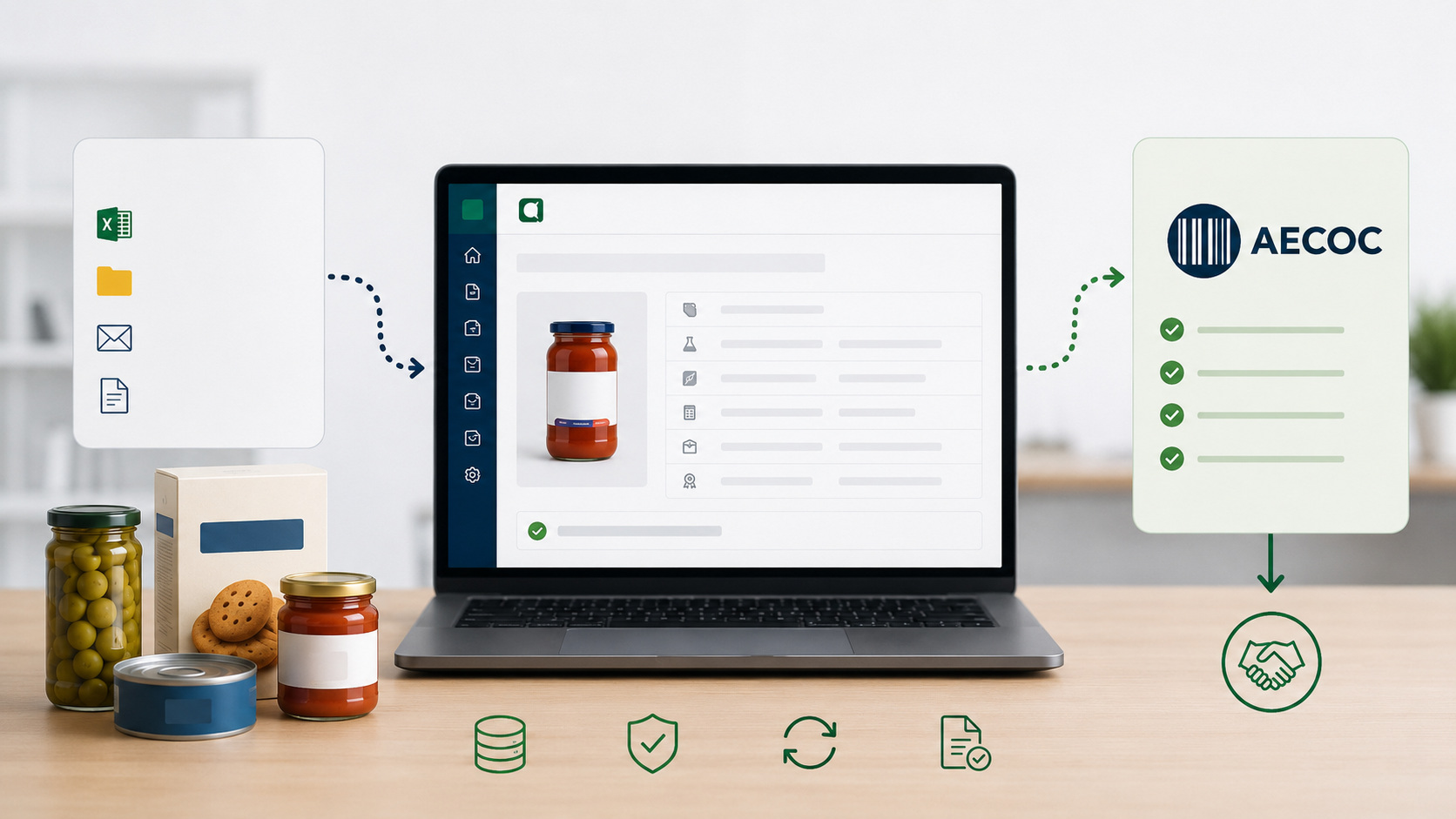
This can become challenging when product information is spread across spreadsheets, internal systems, emails and different departments. Ingredients, nutritional values, allergens, logistics information and legal product descriptions all need to remain accurate, consistent and up to date.
This is where a Product Information Management (PIM) system becomes particularly valuable.
In this article, we explain what AECOC means for companies selling food products in Spain, why product data management can become complex, and how a PIM such as Alimentium helps companies prepare, manage and exchange product information more efficiently.
What is AECOC and why does it matter when selling food products in Spain?
AECOC (the Spanish Association for Commercial Coding) is a non-profit business association that brings together manufacturers, distributors, and other companies operating across the consumer goods supply chain in Spain.
Its main function is to improve the efficiency and competitiveness of the supply chain through the standardisation of processes, data, and best practices.
AECOC acts as the Spanish representative for international standards developed by GS1, which establish the rules for identifying and structuring product data within the supply chain. In the food sector, its role is particularly relevant, as it establishes a common language that allows manufacturers and distributors to exchange product information reliably.
For an international food manufacturer or brand, this matters because some Spanish retailers or distribution partners may require product information to be provided according to specific data structures, formats or industry processes associated with AECOC and GS1.
In practice, it requires structured information such as:
- Product identification (GTIN);
- Ingredients;
- Nutritional values;
- Allergens;
- Logistics data;,
- Legal product names and description;
- Packaging and product characteristics.
Furthermore, this information must be aligned with current regulations, such as Regulation (EU) 1169/2011 on the provision of food information to consumers, which governs key aspects of labelling, nutritional declarations, and allergen communication. Regulatory compliance in the food sector requires clear, up-to-date information across all channels, from the point of sale to shared product sheets for distributors and digital catalogues.
Thanks to this standardisation, major retailers can trust the quality of the data they receive, and brands can reduce errors, rework, and rejections. For companies entering Spain, the challenge is therefore not simply to have the right information. They also need to ensure that it is structured, consistent, complete and ready to be shared with each retailer or distribution partner.
AECOC and GS1 product data requirements
To facilitate this data standardisation, AECOC provides companies with various solutions and frameworks.
AECOC tools are designed to ensure ensure that product data follows agreed structures and formats, making it easier for retailers and manufacturers to work with the same information across the supply chain.
These processes may include checks to ensure that:
- Mandatory fields have been completed;
- Product identifiers are correct;
- Information follows the required format;
- Nutritional and allergen data are properly structured;
- Legal information is complete;
- Logistics data are consistent.
However, these tools and standards do not solve the entire product information management problem.
Before a company can send reliable information to a retailer or an AECOC-related system, that information first needs to be created, maintained, validated and governed internally.
This is where one of the main challenges arises: AECOC defines "how" data should be shared with its partners, but it does not manage "where" or "how" that data is created and maintained internally within your company. Without a centralised system, feeding these tools correctly becomes a manual, slow, and error-prone process.
The challenge of managing product information without a centralised system
In many food sector companies, product information is managed in a fragmented way.
Technical teams may manage ingredients and formulations, marketing teams may maintain product descriptions and claims, logistics departments may work with packaging and pallet information, while nutritional data may be stored in separate documents or spreadsheets.
When these sources are not connected, inconsistencies quickly appear.
One system may contain an updated allergen declaration while another still contains an older version. A retailer may receive different information from that shown on an e-commerce product page. A logistics change may be updated internally but not reflected in the information shared with a distribution partner.
This fragmented approach makes entering a new market particularly difficult because each retailer or channel may have its own data requirements.
Dependence on manual processes and risk of errors
Without a single system for product data management, updates often depend on manual processes.
A change to an ingredient, nutritional value or legal description may require teams to review several files, update multiple systems and resend information to different partners.
This takes time and significantly increases the risk of human error.
It can also slow down product launches and make it more difficult to react quickly when product information changes.
Difficulties in meeting AECOC requirements
These shortcomings become especially visible when companies need to meet AECOC requirements or update their product database. Without a clear structure, validating that information is complete, correct, and aligned with standards becomes a complex and unreliable process. Each update is handled reactively, rather than following a defined and controlled workflow.
Lack of traceability and commercial and legal risks
When there is no central source of product information, it can also be difficult to determine:
- Which version of the data is current;
- Who changed it;
- When it was changed;
- Which retailers or channels received the update.
This lack of control can lead to commercial incidents, rejections by retailers, or even legal issues related to incorrect or outdated information. Without a single view of the product, complying with AECOC standards ceases to be a scalable process and becomes a constant struggle.
How Alimentium helps companies manage product data for the Spanish market
A PIM like Alimentium acts as the central system where all product information is concentrated for the company.
Instead of maintaining information across disconnected files and departments, companies can work from a single, controlled source of product data.
This is particularly valuable when entering markets such as Spain, where companies may need to adapt their existing product information to the requirements of local retailers, distributors and industry data standards.
Native alignment with AECOC and GS1 standards
Alimentium is designed to organise product data according to the requirements defined by AECOC and GS1.
The system simplifies the management of mandatory fields, standardised formats, and pre-validations, ensuring that information is complete and ready before it is shared.
In this way, the connection with AECOC no longer depends on manual processes and becomes a structured, more secure, and efficient workflow.
For international companies, this means that product data created for other markets can be centralised and then adapted more efficiently to the requirements of the Spanish market.
Automation and continuous information updates
Another pillar of a PIM is the automation of food product data.
Any change in ingredients, nutritional values, allergens, or legal information is updated centrally and automatically propagated to different channels and business partners.
This reduces duplicate work, avoids inconsistencies and helps companies react more quickly when product data change.
It becomes particularly important for brands with large catalogues, frequent product updates or operations across several countries.
Preparing product data before sharing it with retailers
A PIM also changes when product information is prepared.
Instead of waiting until a Spanish retailer requests a particular set of data and then adapting the information manually, companies can structure and validate their product data in advance.
This makes it easier to:
- Identify missing information;
- Validate mandatory attributes;
- Maintain consistent terminology;
- Prepare market-specific data;
- Reduce the amount of manual work required before publication or exchange.
The result is a stronger and more scalable product data foundation.
How does a PIM support product data exchange with AECOC-related systems?
A PIM acts as the single source of truth from which data is structured and validated before being sent to AECOC tools.
Instead of manually entering information into different systems, the PIM software organises attributes according to GS1 standards and prepares the content for exchange.
Consider, for example, an international food brand selling a product in Spain.
After the product has already been listed, the formulation changes and the allergen information needs to be updated.
With a fragmented system, the company may need to check several spreadsheets, documents and internal systems before identifying the correct information. Teams then have to make sure the same change reaches every relevant retailer and channel.
From complying with AECOC to optimising product data management
For international food brands, entering the Spanish market can introduce new product data requirements.
Depending on the retailers and distribution partners involved, companies may need to structure and provide their information according to AECOC- and GS1-related processes.
However, the real challenge is broader than meeting the requirements of a single organisation or system.
Companies need a reliable way to manage product information across markets, retailers and channels.
Alimentium helps create that foundation by centralising product information, improving data quality, reducing manual processes and making it easier to prepare data for different market requirements.
As a result, adapting product information for Spain becomes part of a controlled and scalable product data management process rather than a separate manual task.
Planning to sell your food products in Spain?
Discover how Alimentium can help you centralise, validate and prepare your product information for Spanish retailers and AECOC-related data requirements.
Contact our team to find out how to simplify product data management across markets and distribution channels.